Guide
How to store and care for homeopathic remedies
Remedies are low-maintenance but not no-maintenance: heat, sun, strong odors, and sloppy handling are the traditional cautions. The practical version.
2026-07-05
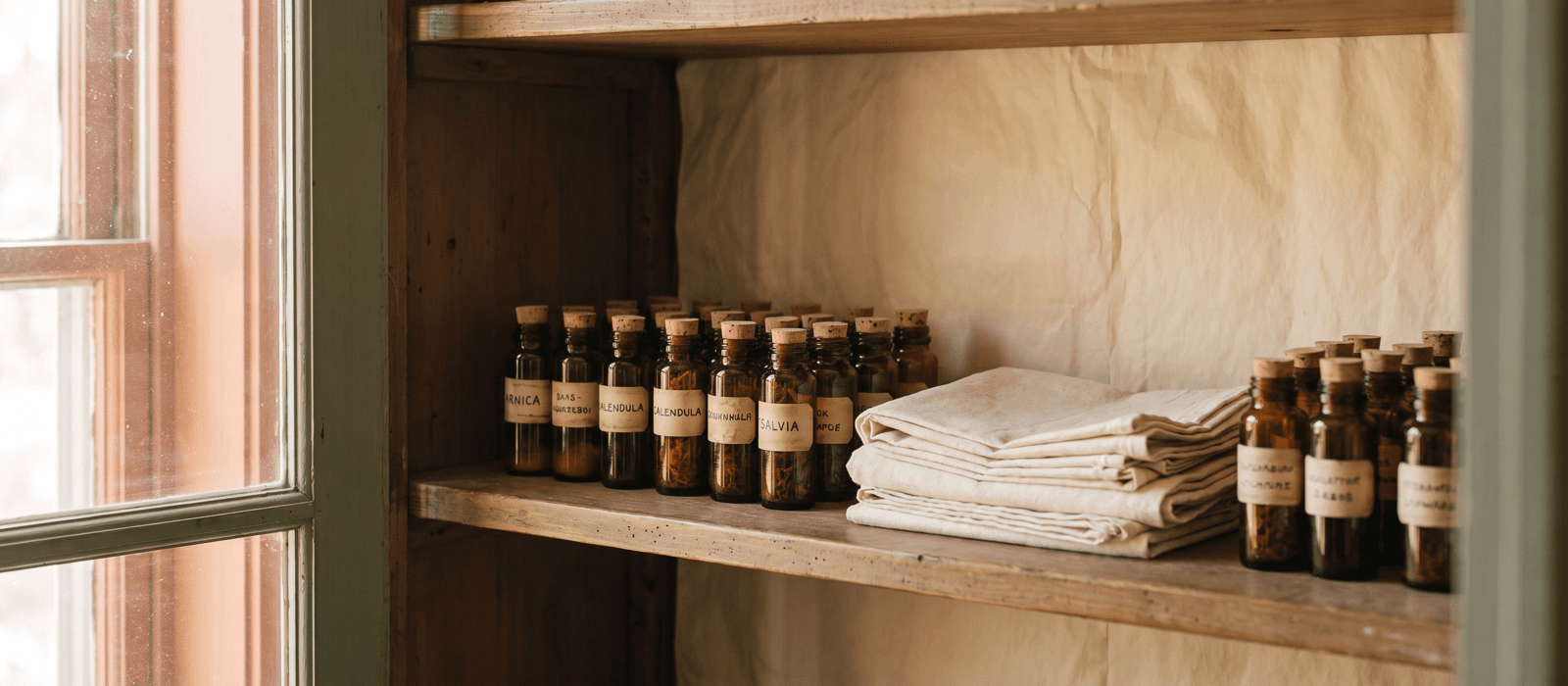
For a product category surrounded by so much lore, remedy care comes down to a short list of habits — most of them the same common sense you would apply to storing tea or spices, plus a few conventions particular to the tradition. Here is the practical version, with the reasoning visible.
The four traditional cautions
- Heat. The universal one. Keep remedies away from radiators, stovetops, sunny windowsills, and parked cars in summer — the glovebox is the classic way to cook a travel kit. A cupboard at ordinary room temperature is fine; refrigeration is unnecessary.
- Direct sunlight. Amber glass exists for a reason; help it by storing vials in a drawer, box, or kit case rather than on open display.
- Strong aromatics. Tradition holds that remedies should not live next to camphor, eucalyptus, menthol, mothballs, or perfume — so the bathroom cabinet full of vapor rub is, by convention, the wrong neighborhood. Whatever weight you give the tradition, a cool scent-free cupboard costs nothing and settles the question.
- Handling. The convention: tip pellets into the cap or onto a clean spoon rather than fingering through the vial, keep vials closed and dry, and never return spilled pellets to the container. This is ordinary hygiene for a sugar-based product as much as tradition.
Labels are the actual asset
The most common real-world failure is not spoiled remedies — it is illegible ones. A vial whose label has rubbed away is worthless no matter how carefully it was stored, and close Latin names make guessing genuinely unsafe practice. So: keep original labels dry and intact, re-label immediately if one lifts, and record both name and potency — Arnica montana 30C, not "the arnica." A kit inventory card (remedy, potency, date acquired) turns a drawer of vials into something maintainable.
Shelf life, honestly
Properly stored pellets are remarkably stable — a dry, cool, closed vial does not "go off" the way a liquid does, and homeopathic products in the US carry labeling under the same regulatory framework described in our contents guide. Respect any printed expiration, and retire anything with actual physical evidence of trouble: moisture inside, clumped or discolored pellets, a compromised cap. When in doubt, replacement costs little; made-to-order preparation exists for exactly this.
Keep them away from small hands anyway
Remedies at common potencies are not a toxicity concern — but a household rule that all health products live out of children's reach is simpler and safer than a rule with exceptions, especially in homes where real medications share the shelf. Sweet pellets in easy reach also have a way of becoming snacks, which is mostly a replacement-cost problem, but not a habit worth teaching.
The annual five minutes
Once a year — the seasonal kit review is a natural moment — open the case: check labels, check caps, note gaps against your household's actual last-twelve-months history, and update the inventory card. Five minutes keeps a kit trustworthy for the moment it is actually reached for; and if the review turns up a pattern that kept recurring all year, that observation is worth more than any restock — bring it to a conversation.